
A portable 'granny' cable that plugs into a 13 amp socket can be a temporary measure. It is slow, often around 2 kW, and a standard socket was not designed to run near its limit for many hours, night after night. Warm plugs, tired sockets and extension leads are how these setups become fires. A dedicated wallbox on its own circuit is the permanent UK approach for a car you park at home.
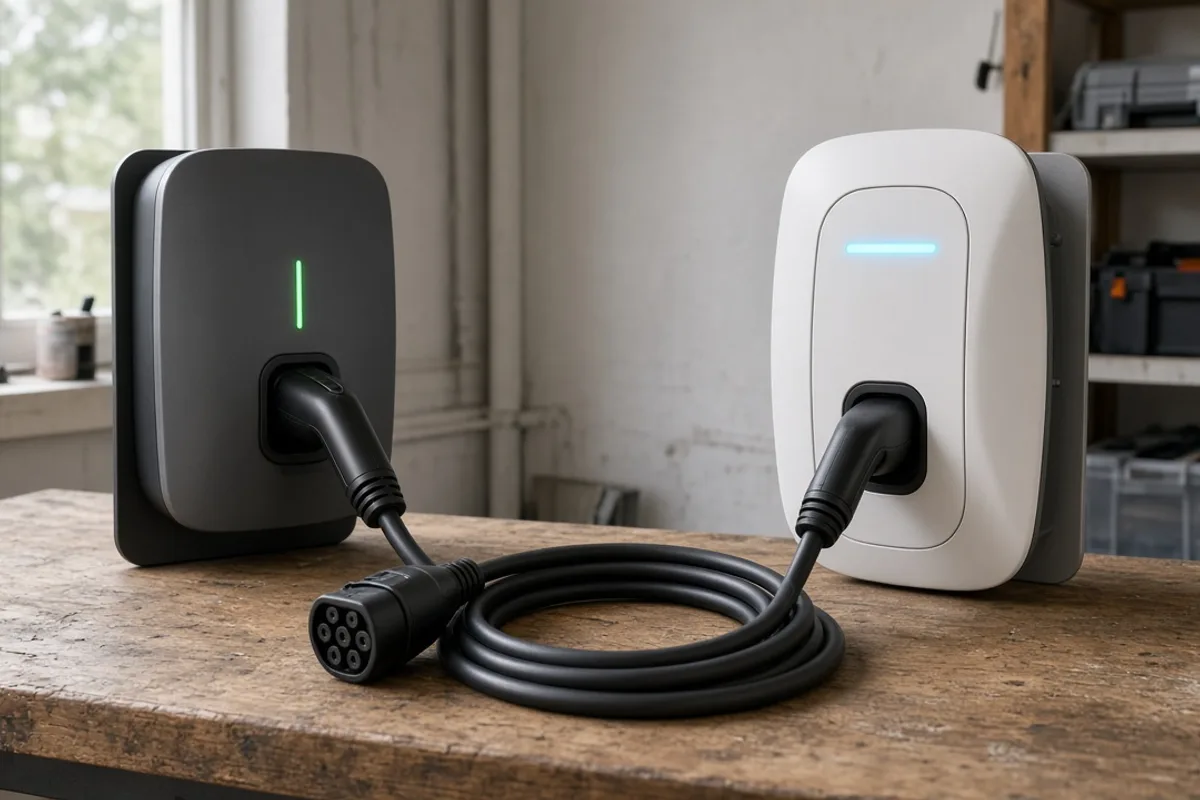
Handover when three-pin granny cables versus a home wallbox is the issue
If you are replacing a granny lead, ask the quote to include removal of any temporary arrangement and a dedicated circuit, not a new socket on the ring main.
Three-pin granny cables versus a home wallbox
Occasional use while you wait for an install is a different risk from using a granny lead as the only charger for a high-mileage job. Extension leads, cable reels and multi-way adapters are not part of a safe setup.
- 13 amp charging is slow and hard on sockets
- Extension reels are a known overheating risk
- A wallbox uses a dedicated circuit
- Pavement leads are not a workaround
What a survey must prove about three-pin granny cables versus a home wallbox
If you are still on a portable lead, have the socket checked before you lean on it, and book the proper install. Do not run the lead across a pavement.
Three-pin granny cables versus a home wallbox and the written scope
The wallbox costs more than the lead that came with the car and it is the correct product. Trying to save the install by 'just using the socket' is how people pay twice: once for a damaged outlet, then for the charger.
The expensive shortcut on three-pin granny cables versus a home wallbox
The mistake is a reel wound up under load, which overheats, or a lead through a letterbox. Both are well known and both are avoidable.
Frequently asked questions
Is a heavy-duty socket enough?
A good outdoor socket is better than a tired indoor one and it is still not a designed EV circuit. Treat it as temporary.
How slow is it?
Often around 2 kW, so roughly 8 miles of range an hour. A 7 kW wallbox is several times that.
Does the car maker allow it?
Many supply a portable cable for occasional use and still expect a proper chargepoint at home. Read their wording.
Will insurers care?
A fire from a misused lead is a bad claim story. A certified charger is the cleaner record.
Core buying guides
Start with these high-intent guides, then dig into the rest of the library.
Related guides
Sources and further reading
How this guide was prepared
This guide was written by the Local EV Installers Editorial Team. We compare official guidance, legislation and established consumer information, separate general information from project-specific advice, and show publication dates and sources. We do not accept installer accreditation claims at face value.